The following documents contain some additional tips and information that hopefully will add to your understanding and experience as you prepare to visit Canadian cemeteries and memorials in France and Belgium.
About WW1 Cemeteries & Memorials
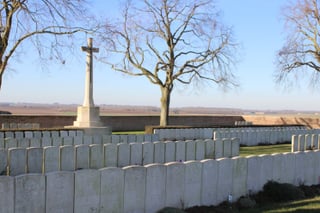
The Commonwealth War Graves Commission's map book of cemeteries in Northern France and Belgium lists hundreds of sites in that area alone. They range in size from tiny battlefield cemeteries to large "collective" ones with burials from multiple battles and relocations from other sites.
Around the towns of Vimy, Arras, Amiens and Cambrai, where Canadian troops were victorious in several key WW1 battles, the extraordinarily high cost of these victories is evident in the many military cemeteries that dot the landscape.
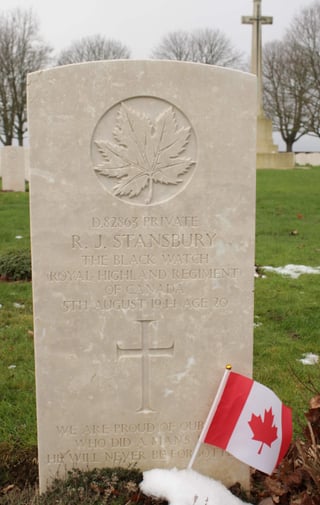
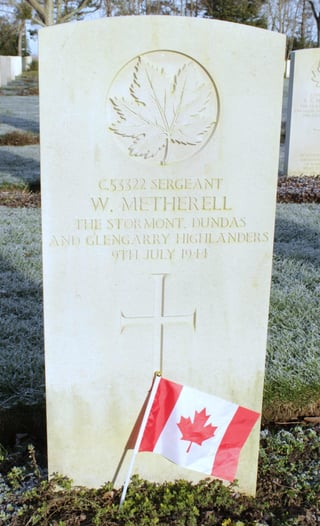
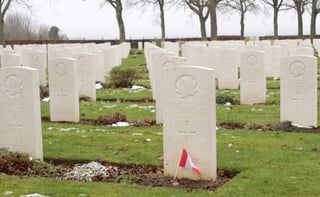
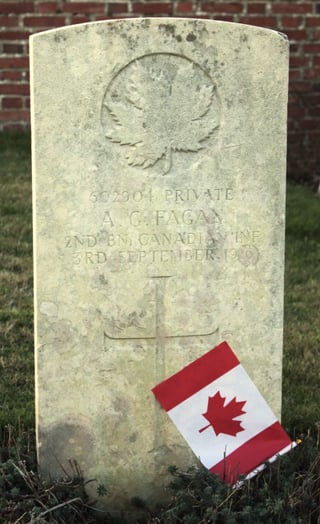
Canadian burials from this war can be found in "Canadian" cemeteries, where virtually every headstone shows the maple leaf, as well as in "Commonwealth" and "British" military cemeteries, where the maple leaf can be found among the headstones of the British and other allied soldiers at whose sides they fought and died.
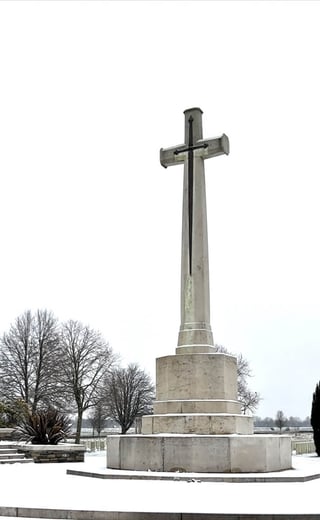
WW1 Memorials: The largest memorial is the Canadian National Vimy Memorial which honours all Canadians who served during WW1. It bears the names of those who died in France and have no known grave. The memorial is located at Vimy Ridge where, on April 9, 1917, four Canadian divisions fought together for the first time and gained control of this strategic hilltop.
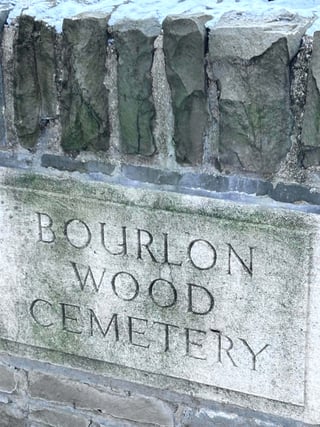
There are four other Canadian memorials in France at Bourlon Wood, Courcelette, Dury, and Le Quesnel, as well as three in Belgium at Hill 62, Passendale, and Sint Juliaan. The latter is the striking "Brooding Soldier" while the others are solid granite blocks of remembrance with a description of the battle in English and French.
About WW2 Cemeteries & Memorials
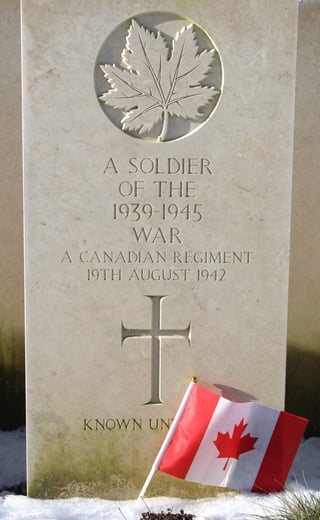
Canadian cemeteries from WW2 contain burials from multiple battlefields and towns in nearby areas. Begin with Dieppe, where 708 Canadians are buried in a quiet cemetery just south of town, most from the unsuccessful landing on August 19, 1942 but, also, from the later successful liberation of the town in 1944.
At Beny-sur-Mer Canadian War Cemetery, near the Juno Beach Centre, and at Bretteville-sur-Laize Canadian War Cemetery, south of Caen, are the resting places of more than 5,000 Canadian soldiers who lost their lives either at the June 6, 1944 landing, or on subsequent days in bloody, often deadly, battles to liberate Caen and nearby airstrips and towns. Further north, where multiple Canadian divisions engaged in operations to free strategic port cities on the northern coast of France, the Calais Canadian War Cemetery is the final resting place for 594 Canadian servicemen.
WW2 Memorials: There are Canadian memorials in many towns across France and in other countries. At Dieppe, along the quay and in the villages to the east and west are multiple memorials to the various regiments that came ashore in an effort to break Hitler's Atlantic Wall and help to liberate Europe.
In Normandy, at an area code-named "Juno", the beach towns of Courseulles-sur-Mer, Bernieres-sur-Mer and St. Aubin have touching memorials to the sacrifices made by numerous Canadian regiments that made it ashore on June 6, 1944 and suffered terrible losses. Canada's Juno Beach Centre at Courseulles has wonderful displays and interactive exhibits, as well as a tour of an observation bunker at the shore.